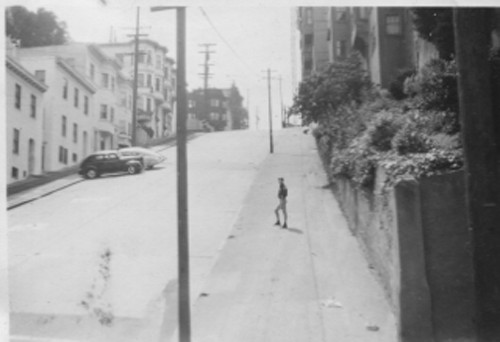
A steep street in San Francisco
ASHLEIGH BRILLIANT 1951 TRIP - PART 4
August 15- September 3. The Long Road Home
Wednesday, August 15th, 1951
(Written August 16th) Today at last we left Los Angeles. Uncle
Marsh woke us up this morning and then went off to work. He told
us to phone him before leaving, but he was out both times when
we called. We had breakfast, did our last packing, said goodbye
to Mrs. Mark & her daughter downstairs, & were off. We
had with us 2 new signs which we had made. These bore inscriptions
"BRITISH STUDENTS" "TOURING U.S.A." "BOUND
FOR YOSEMITE." Uncle Marsh had given us stamped postcards
to send to him airmail every other day to let him know we are
alright.
Our problem was to get out of Los Angeles and onto the road for Fresno and Yosemite. Uncle Marsh had given us some instructions & we first took a street-car to Western and then a bus to Santa Monica Blvd. Then we got on a red streetcar & went a long way to a district called North Hollywood. There, asking directions, we were directed onto another bus going in the direction of San Fernando and the highway to Fresno. At last we got off, & were on the right road. But we were still in a built-up area, and we were just standing by the roadside wondering what to do next when we saw that a car had stopped for us just a little way up. We ran up to it & found inside a pleasant fairly-young man whose name we later learned to be Mr. Wark, at the wheel, and another young man who was a deaf mute. Mr. Wark said he would be going about a hundred miles in our direction before turning off, & we got in with him. The deaf mute was, surprisingly enough, another hitch-hiker whom he had picked up further back. He was going to Washington D.C., & went on with us for some miles before he got out where his road turned off.
Mr. Wark told us that he lived & worked in San Francisco, & was just returning there after visiting his family in Pasadena. Although we had intended to make straight for Yosemite & not to go to San Francisco, we decided, now that the opportunity was offered us, to go with Mr. Wark all the way, since we did want to see "Frisco" as well. And so today was a day of journeying north from Los Angeles to San Francisco. Mr. Wark was a likeable man, and we learned that he is a meteorologist (weather-man), and that he has traveled a great deal, mostly by air. He has been all over Europe & worked in Egypt. He also mentioned being in the Pacific area in the navy & in Hawaii. We naturally talked a lot with him & learned much about California. Our route was over the mountains by the Tejon Pass, then down into the flat desert region along highway 99, and then by 166 to Maricopa - Taft - Mckittrick - Paso Robles - Salinas, and along the coast to Half-Moon Bay. Mr. Wark said he lived by himself at Half-Moon Bay, & we could stay the night at his house if we wished. We gladly accepted.
The mountains were bare, the desert hot. In the desert region we went through a large oil-field area, where we saw oil-wells in very great numbers. I had never imagined that oil-fields were so crowded with wells. It was the first real oil-field I had seen & the sight was ugly, but rather impressive. At Taft, an oil town, Mr. Wark treated us to lunch. I had hot beef sand., orangeade, pie. I never cease to marvel that in the hottest barest parts of the desert there are places where one can sit in air-conditioned comfort sipping cool drinks.
The distance was 400 miles, and we traveled all day. As we came further north, the weather became cooler and we ran into some fog. For much the last part of our ride, the fog was really thick, & visibility was only a few feet.
At one town (I think it was Paso Robles) we came upon our first Californian mission. The missions were settlements built by the early Spanish settlers to serve as dwellings, churches, schools, and forts. At this one we went inside the church part, & heard a very unpriestly-sounding priest lecture on the building which was about 140 years old. There was an altar & the walls were rather gaudily painted. The place was cool & damp.
Mr. Wark treated us to other refreshments on the way. When we were nearing the end of the journey, we were passing through a town when there was a slight thud against the car, and Mr. Wark said that he had just hit a dog. He drove back to the place a minute or two later, & saw a group of children standing around something in a garden. The dog had been killed. A little girl was crying loudly. Brian & I stayed in the car, but Mr. Wark went out & spoke to the girl & went into the house. A little while later the girl ran out &, still crying, called to the boys around the dog, "Mommy says not to bury him yet." "He's dead alright," called back one of the boys. A short time later Mr. Wark returned, & we drove off. He did not seem very much concerned. The incident upset me a little, & that night I dreamt that we were put in prison for running over the dog & somehow I returned to Happy, but he had turned completely white.
At last we reached Half-Moon Bay in the fog & Mr. Wark drove on past the small town, then up off the road onto several smaller roads & finally drove into a garage. Brian & I fond the air now quite cold. Mr. Wark took us then to his house, which we found quite an interesting place. It was built all of brown wood; I don't thing Mr. Wark lived in the whole place, just a part of it which he rented. There was a small kitchen & the main room was most interesting. It was a large tall room & over one end of it there was a sort of large "balcony" to which a narrow flight of stairs led. The downstairs part was the living room, & the upstairs the bedroom. The bathroom adjoined the bedroom upstairs. In one corner, there was a large stone fireplace downstairs, whose stone chimney went right up to the ceiling, where it ended in some curled metal. At the other end of the room, there was a very large single-pane window.
Mr. Wark had a very large collection of gramophone records of good music, mostly in albums, and he played us some of the records. He gave us food - meat & beans & rolls & Coca-cola, and we slept on a couch in the living-room which folded out to make a bed.
Thursday, August 16th, 1951
Brian & slept fairly well & were up at about 8 A.M. Mr.
Wark continued being very kind to us by supplying us with an excellent
breakfast. I had eggs, milk, tea, toast, & pineapple juice.
As last night, we helped him with the washing-up. He was to begin
work today, but not till fairly late, and so what he did was drive
us the 25 miles to San Francisco & then take us all around
the town. It was still fairly foggy as we drove along the coast,
but we saw the ocean several times & we found it sunny in
San Francisco the whole time.
Frisco is rather older in atmosphere and more formal in manner than Los Angeles. In L.A. very few men wore suits & hats, but in S.F. it was the rule rather than the exception. The climate in S.F. is very definitely cooler & much more foggy than L.A. & we saw few palm trees. Residences, however, appeared to be about the same type, though we saw many older-looking buildings. We saw quite a surprising number of interesting things during our pleasant drive around the city. For me, one of the most memorable of these was the extreme steepness of many of the streets. I had never seen streets so steep before, and could not see how cars could get up them if they were any steeper. The gradient must have been about one in 3, and cars parked on them were parked sideways. It did not even seem possible our own car could get up one that we attempted, and, as it happened, it could not. We had almost reached the top when the clutch (whatever that is) failed, and we had to back down to the bottom & go up a less steep street.
I had long heard of S.F.'s two famous bridges, the Golden Gate Bridge, the longest single-span suspension bridge in the world, & the Bay Bridge which is the longest bridge in the world, about 8 miles including approaches. We saw the Bay Bridge first, from a distance, & Brian & I were later to come across it. Then we drove over to the Golden Gate, & I was very disappointed to see that there the fog was so low that all but the horizontal part of the bridge - the actual roadway & beneath - was obscured by it. It was an unusual sight, however, for it looked almost as if nothing was supporting the bridge. Out in the waters of the harbor, we saw the island of Alcatraz on which is the famous prison.
San Francisco is indeed a hilly city, and many fine views may be obtained from the tops of the hills. Because of the steepness of the hills, little cable-cars are used for public transportation. These are like small street-cars, & are pulled along by a cable running underneath the ground. At the end of their runs, they are turned around on turntables in the streets. S.F. is a port and, driving along the shore, we saw many clean-looking docks and piers. Because I wanted to see it, Mr. Wark took us to Chinatown. San Francisco's Chinatown, I have read, is the largest Chinese settlement outside of China. It is centered on California Street, along which we walked. There we saw all Chinese shops selling Chinese clothes, food, art wares etc. It was very interesting.
A steep street in San Francisco
At last our tour came to an end, and Mr. Wark, at our request, deposited us outside the "San Francisco Chronicle" building. We said goodbye & thanks & promised to write him. He had done more for us than practically any other lift we had had. We wanted to go to the Chronicle building because Mr. Morin, the professor at Chicago University, had said that, if we got to San Francisco, we should go to see Mr. Erich Nielson, an assistant to the editor. We went into the building and at an information desk asked for Mr. Nielson. But we were told that he had not been working there for over a year & was now in Mexico somewhere. So we came away, had lunch in a café, & then set out for the Bay Bridge, which we intended to cross on our way to Yosemite. But when we reached the approach to the bridge, we saw a sign saying "No Hitch-hiking" - the first such sign we had seen. We saw a sailor there, however, and, although he was not actually hitching, we realized that he was waiting there hoping that someone would pick him up. And that was what happened in a very short time. So we went over & stood & displayed our signs, & were soon lucky ourselves, for we got a lift which was to take us all the way to Yosemite National Park.
There was a young couple in the car. The man was American, but his wife was English, from Northampton. She had been living over here only five years, but she had no recognizable English accent at all. This was probably because she worked as a telephone operator. The man was a bus-driver. They came from the town of Bakersfield, California, & told us a lot about it. Their original intention was to go straight to Bakersfield, but they were not in a hurry to get home, and eventually decided to take us right to Yosemite. And so we drove with them all afternoon. They treated us to pie, drinks, & ice-cream. They each had their own cars, but the man was now driving his wife's car. We got to talking about driving, & to our surprise, the man offered to let Brian drive the car. Brian had never driven before, but the man later said that he thought he had. And so Brian actually drove the car for about 5 or 10 minutes. He managed to steer fairly straight, but I was worried. Once he almost ran into the back of a car because he didn't know where the brake was. And so we all came through safely, & Brian seemed to have enjoyed it.
For a long time the country was fairly flat, but then we began to climb up into the mountains, & went along a narrow winding road. We were up quite high & there were trees everywhere. We passed by some very large old trees, & I got out & walked along one. At last we reached the entrance to the park & the fee for the car was $2. We drove along right up the Yosemite Valley, past many camping grounds to the administration building where we bade goodbye to our kind friends & then enquired about accommodation. We learned that the cheapest place to stay was at the tent cabins where it would be $2 each. And so we took a cabin for the night. We had separate comfortable single beds & I liked the cabin.
Friday, August 17th, 1951
(Written evening August 18th) Yosemite, like the Grand Canyon,
has the status of a National Park, & thus contains no permanent
residences or unnecessary shops etc. We had a breakfast of some
food from our rucksacks & then went outside to look around.
It was one of loveliest valleys I had ever seen. The floor was
broad & flat, partly meadow & partly wooded. All along
the sides rose steep almost vertical tall rock faces high into
the sky. There was a place where one could rent light bikes for
35¢ an hour & we each took one & rode separately
around the east end of the valley. I was disappointed that all
the main waterfalls were at this time of the year completely dried
up. I had particularly wanted to see Yosemite Falls. My ride lasted
about 80 minutes & I paid 55¢. Then I started to write
the remainder of this week's "Edgware Post" article.
The sun grew hot. The scenery was really magnificent. We had lunch in the cafeteria. There were many people about & there are quite a few buildings, including a lodge, swimming pool, & a laundry. There are many camps & campers walking about with few clothes. After lunch, I went to see the Yosemite Museum which Brian had already seen, & there I heard a ranger lecture on the formation of the valley.
We saw Half-dome, the famous cliff-top rock formation. Afterwards we sat by the swimming pool while I finished off the article which, because of pressure of time, I had to make shorter than usual. Then we had to be on our way again. It was the first time that we had actually hitch-hiked in California. After a wait we got a lift with 2 people who took us part of the way towards the place where we could get the road going East across the park. Then we were lucky, & our second lift, with parents & two sons, took us all the way to Tuolumne Meadows, almost at the Eastern edge of the park. We rode for a long time along the winding mountain road through all wooded coniferous areas. A 21-mile stretch of the road was particularly bad, -- poor surface, narrow, & winding. It followed an old mining road. We were fortunate, because the man driving knew the road well & did not have to go as cautiously as the other drivers. He had a slight accent & sounded intelligent & I felt somehow that he must be a University professor. Later I discovered that he was, -- at some California Univ.
At Tuolumne Meadows there was a camping ground where these people were staying. They gave us some food - an uneaten lunch, & left us & we tried to hitch out. We stood on a bridge. All around were bare rock masses in the distance. It was growing dark. Then a bearded young man came up to us & introduced himself as Bernie Bloom. He said the people with whom we had ridden had told him about us, & he wanted us to stay with him in the camp for the night. We agreed, & he took us to the camp of some young friends of his, among whom were a young teacher of English & his wife & child. They had a regular camp & campfire & gave us some food - eggs & tea & hot chocolate. Brian made the tea. It was enjoyable talking with these people & they were kind to us. Bernie did some card - & sleight-of-hand tricks & told some jokes. He took us to the camp of the people who had driven us & we sat around their fire for a while. Then he took us to his camp & said we could sleep in his car parked there. He always slept out in the open. Some people loaned us some blankets I slept in the front seat, Brian in the back since he is taller.
Saturday, August 18, 1951
(written August 19th) I hardly slept at all last night. I had
very little space in the front of the car & just couldn't
get to sleep. Brian slept well in the back. It was cool when we
woke up. We were at an elevation of about 10,000 feet.
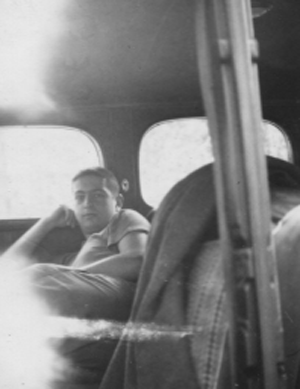
After night in car.
Bernie Bloom was quite a character & he
seemed to know everyone camped round about. He was studying art,
& showed us some sketches he did of the mountains. He also
seemed to be a part-time student. Like most of the other young
men we met in the camp, he was growing a beard. He was very friendly
& we soon felt we had known him a long time. He cooked us
a breakfast of porridge & tea & pancakes & was anxious
to know what we thought of his cooking. We praised the pancakes.
He gave me his address & we promised to write. After breakfast
we prepared to leave & said goodbye to all the people we had
met in the camp. Bernie took us down to the main road & there
he left us & we waited for a lift. All around were mountains
and forests.
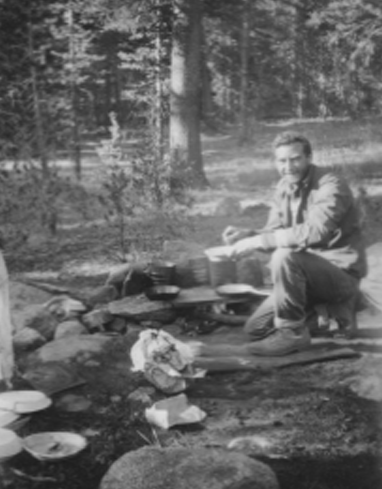
Bernie Bloom at Tuolumne.
We soon got a lift with 3 people who were going hiking. They took us to Tioga Pass, right at the Eastern entrance to Yosemite Park, by a ranger station. There we waited a while, & the ranger, a young man who was a student at Fresno, came out to talk to us. He said that he would try to get a lift for us. We told him we were going to Reno. All the cars had to stop at the station, & he asked many of them if they were going to Reno, but they all seemed to be going the other way. We waited quite a while & began to get hungry. I asked the ranger if we could get any food anywhere, & he very kindly brought out a can of apricots & 2 spoons & an opener & gave the food to us for nothing. We had soon eaten all the apricots. Then at last the ranger got us a lift with an elderly couple who were going to Reno & we rode with then all the way. Their name was Neel, & Mrs. Neel talked a lot with us. She was a keen photographer l& took several pictures on the way. They lived in Fresno & were on their way to visit their married daughter.
Our route was down to the 395 highway, then along it through Carson City. The scenery was often very impressive. It rained quite heavily for a while. And so we left California, & were in Nevada for the 2nd time. At last we reached Reno. Mrs. Neel phoned her daughter, & she came to meet them in her own car. (We had had meals at places en route.) Brian & I had an address in Reno. It was another one given to us by Mr. & Mrs. Morin in Chicago. The address was of a Mr. & Mrs. Ralph Wittenburg, whom the Morins said we ought to look up. All that we knew about them was that Mr. Wittenberg was a lawyer & owned a radio station. The Neels drove us to right outside the Wit. home & left us. We knocked & introduced ourselves & Mr. & Mrs. W. invited us inside. They talked with us for a while, gave us ice-cream & cokes & showed us round their home, which had every modern convenience. Then Mrs. W. phoned up a friend of theirs who rant the local Y.M.C.A., & although there were no vacancies, this friend said we could sleep on a folding-couch in his office, & that is what we did. Mr. W. drove down there & then took us out to dinner, walked us round the town a bit & showed us round a small studio which his station KTOA owned. He also took us to his law office & showed us a very small radio that he had. We learned Mr. & Mrs. Morin were each divorcees, & that is how they met the Wittenbergs in Reno. They had a sort of "exchange-divorce" with 2 other people. Jennifer is probably Mrs. Morin's child. Mr. W. took us to a hotel where Frank Sinatra, the famous popular singer, was singing. We saw him from a distance. At last we went back to the "Y."
Sunday, August 19th, 1951
(written August 20th). We slept only fairly well at the Y.M.C.A.,
not being able to get to sleep for some while. We were up at 8:15.
Mr. Wittenberg had arranged for us to have breakfast at a restaurant
at his expense. The place was called Tiny's, & we had waffles,
milk, & sliced pineapple. Then we phoned Mr. W., as he had
asked us to do, & he came in his car for us, to take us out
of the town. Reno was like Las Vegas, full of open legalized gambling,
but it seemed somehow slightly more dignified. Reno, of course,
is known all over the world as place where quick divorces are
obtainable, but, although we saw the courthouse from the outside,
we saw & heard very little about divorces. Mr. W. took us
right to the edge of Sparks, the small town adjoining Reno. Before
he left us, he offered us a $5 bill, but, as with other offers
of money we have had, we declined it.
We had to wait quite a while for a lift. Once we went across the road & bought a Royal Crown Cola each. Then at last we were picked up by a young man & his wife in a small car. The interior of the car was in a broken-down condition. The woman was barefoot. I never understood the position exactly, but seemed that they had originally come from Pittsburgh, Pennsylvania, had been living in California, & were now on their way back to Pittsburgh, whether to stay or to visit I don't know. So we rode on with them into the Nevada desert. Nevada has the smallest population of all the states, only about 130,000, & we saw very few settlements. For the most part, it was just desert & bare mountains. We stopped at the small place of Lovelock for lunch. Brian's & my destination was the town of Wells, Nevada. Winnie Shuter, a girl Brian & I (he better than I) know at school had a pen-friend there & when she knew that we were coming over this summer, she wrote to her friend. The friend replied, saying that she & her husband would be glad to see us if we ever got to Wells. And so we were going to look them up, hoping that we might be able to have a meal & a bed there.
Wells is about 326 miles from Reno, & we thought we would be sure to get there, as our driver was going right on through. But then a strange thing happened. Some miles out from Lovelock at a filling station, our driver stopped the car. We didn't understand what was going on for a while, but then he said that he couldn't go any further as he didn't have enough money. He had hoped to reach an uncle in Salt Lake City, but the money had not lasted & now he would have to leave the car where we were, & he & his wife would have to hitch-hike themselves. This was very odd. They were first going to rest a while before hitching on & so we had to leave them & get onto the roadside in the hot sun & start hitching again. We were opposite a cafe, & went over once to have a drink. But finally we got another lift & this one took us all the way to Wells. We rode with a man & wife from Kansas who were on holiday. We have now spoken to so many people that the same questions & subjects keep coming up time & time again. Of particular frequency is the question of where we are in school & we have to go into a detailed explanation of how our school system is different & the standard of education is higher.
We went right across Nevada, through Winnemucca & Elko, where we had a meal, & finally reached Wells at about 8:30. It was a very small town. We left our driver & his wife & went over to a gas station. All we knew was that we had to contact a certain Andrew Knudson whose telephone number was 10F4. He lived, we had been told, on a ranch. From the gas station, Brian phoned that number, but there was no reply. Part of the station was a soda-fountain & a girl there said she knew Andy Knudson (pronounced Kenoodson) but didn't know where he was. We waited around for a while, trying to get information from other people, & finally someone told that he would probably be at church. They directed us to the church & we walked there, finding it to be a small Mormon church. We waited at the entrance until the service was over & then asked the people coming out if Andrew Knudson was there. He was not there, but his parents were, & we talked to them & introduced ourselves. They explained that Andy was out riding on the range helping to get the cattle in. It was his wife who corresponded with Winnie Shuter, & she was visiting & staying with some relations in Wendover, about 50 miles away. Mr. & Mrs. Knudson whom we spoke to were elderly & lived on & owned a ranch about 12 miles away. We at first asked them if they knew of anywhere in town where we could stay, & they started to tell us, but then apparently changed their minds & said we could stay the night on their ranch. They drove us out there & I began to feel, from their conversation, that we were really in the cowboy country. The ranch-house was quite isolated. They gave us a meal & we slept in a double bed.
Monday, August 20th, 1951
(written Aug. 21st, 1951) Today was a very interesting & full
day. The name of the ranch we were on was the Knudson Ranch. We
slept fairly well, but Mr. Knudson woke us at about 6:50 this
morning. Mrs. Knudson was a pleasant woman, but she had a rheumatic
heart & had been in hospital recently & was not supposed
to climb stairs. Our bed was in a sort of garret with sloping
roofs. We had breakfast downstairs with Mr. & Mrs. K. They
were living alone in the house since their son & daughter-in-law
were both away.
Mr. K. asked us if we would like to ride a
horse. We had never done so before, & said we would. He took
us outside into a fenced area near the wooden stables & brought
out a rather old brown & white horse named Banjo whom he said
would be easy to ride. Two friendly dogs, one large & one
small kept jumping up on us. There were some sheep in the yard.
There were no buildings apart from the ranch in sight - just empty
fields of sagebrush & distant low brown bare mountains. Mr.
K. strapped a saddle around the horse. He also brought out a pair
of real leather cowboy chaps, used to protect the legs when riding
through rough country, and a wide-brimmed Stetson hat. Brian was
the first to don the garb & mount the horse. He looked like
a real cowboy. I photographed him on the horse & Mr. K. showed
him how to hold the reins. Then he trotted around the area &
didn't find it very difficult. Then it was my turn. Mr. K. buckled
the chaps on me. They are not like trousers & do not cover
all of the lower quarters. I put on the hat as well, then put
my left foot in the wide stirrup & climbed up & over,
& was astride a real horse. The nearest I can remember coming
to such an experience before was riding guided ponies at fairgrounds.
Mr. K. told me to hold the reins in my left hand and try to keep
the lengths equal. The right hand I used to hold the leather thong
for knocking the horse with to make him go faster. Brian took
my picture & I trotted round. I soon learned that the horse
turned in the direction the reins were pulled. Then I got off
& Mr. K got on & showed us how to make the horse gallop
by urging him on. He galloped around, then Brian had a try &
was fairly successful, & it was my turn again.
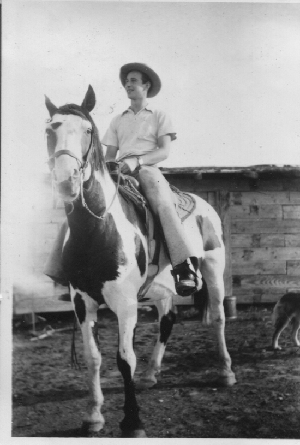
Brian Richmond on Banjo at the Knudson Ranch, Wells, Nevada
I got on & began trotting, "giddaped" the horse a bit, and he began to gallop. I did not feel perfectly secure. Then an alarming thing happened. The horse started to go by a door into a shed (I think it was the sheep-shed.) I was surprised, but couldn't stop him. I didn't realize at the time that I should have pulled hard upon the reins. I said "whoa" a few times, but Banjo didn't stop. The door, of course, was much too low for me & all the time I didn't think that Banjo would go right in - but he did! I was knocked backwards, & fell off inside the shed. Fortunately I was not badly hurt & just knocked my side a little. I have a bruise there, & it still hurts a little. I sat down to sit out the pain & was laughing by the time Mr. K. & Brian ran over to the shed. But I didn't choose to ride Banjo any more.
Mr. K. showed us some of his guns & then when we were all ready, he & Mrs. K. who were going to Elko, drove us the 12 or so miles back to Wells. They were Mormons, & had some Mormon books in their home. They showed us some photographs of their family. They left us in Wells, & soon we were on our way again. After a short wait at the edge of the town, which was a very small one, we got a lift with a single man, an auditor from Minnesota who was on holiday touring. We were glad to find that he liked talking, and, for a change, he did most of the talking. He told us about his travels in Mexico & the U.S. & exciting bits were punctuated with words "Hell," "Christ," & "Jese," which usually introduced sentences. But he was a pleasant man & told us some interesting things.
Brian & I decided to go to the town of Wendover, about 46 miles from Wells where Janet Knudson, whom we had really come to Wells to see, was staying with some relations. Mr. & Mrs. Knudson had told us that if we wanted to see Janet we should ask at Wendover for Mr. Fred Devaney. We got off at Wendover & asked at a gas station for Mr. Devaney. We were directed to another gas station at the other end of town. Wendover was a smaller place than Wells & had few buildings. It looked pretty miserable & dry. Beyond it to the East lay the Salt flats of Utah, a huge flat white expanse of salt with which we were later to become better acquainted.
As we were walking along the street towards the 2nd gas station, a man drove up beside us in an open MG British car of a type which we have frequently seen here. He asked us if we were English & when we told him we were he said that there was in a garage nearby an English car which had just that day broken a speed record on the famous track on the Salt Flats where many records have been made. I believe the record was for a ten-mile distance on a circular track. A friend of his drove up in another MG. I got in one, Brian in the other, & off we went the short distance to the garage, which was just next door to the garage for which we were making. We went inside, & there was a small streamlined racing car being worked on by some English mechanics. We spoke to them for a while. The car engine, we were told, was an ordinary stock MG engine. We looked at it & found a lot of salt in it. It had been driven by Colonel Gardner, an Englishman who holds many speed records. We left after a while & did not meet Colonel Gardner. Incidents like this, interesting & unexpected, lead me often to say "we can never tell what's going to happen next!" We were to have more surprises today.
We went to the garage next door & asked for Mr. Devaney. He was not there, but a man there showed us to his house a short distance away off the highway, one of a group of wooden houses. The land was dry & the house had only a tiny lawn in back. We knocked at the door & asked the woman who answered whether Janet Knudson was there. Janet was called, came to the door, looked at Brian, & exclaimed "Why, I bet you're Brian!" We were taken inside & sat down & were given ice water to drink. We met Mr. Knudson's mother, a stout elderly woman. The woman who answered the door was Mrs. Devaney & later Mr. Devaney came in. I'm not sure what relation they were to Janet. Janet was young, full-faced, & pregnant. After the initial discussion, she didn't seem to have much to say. Brian talked to her a little about Winnie Shuter. Janet said she had never thought we would really come. We too had until only recently considered the chance remote. Janet had corresponding with Winnie Shuter as a pen-friend for about 4 years.
We had lunch at the house. Despite its location, the house seemed quite ordinary & well-furnished. There was a refrigerator etc. The food, as at the ranch, was not dished out, but was passed around, & everyone could take what they wanted. Unlike the Knudsons at the ranch, a grace before eating was not said. We had meat, potatoes, vegetables, bread, & pears. After lunch, we talked for a little while longer. Fred told us that, although many people thought he was crazy, he liked living in Wendover. He had his house & garden, & there was hunting about. He showed us his guns.
Finally, we left at about 1 P.M. & were on our way once more. Wendover is just inside the state of Utah, a new state for us. We waited for a while at the edge of town, holding our "BRITISH STUDENTS" sign as usual for the cars to see. We never hitch-hike without it. And then we received a lift which was to prove a very interesting and fortunate one for us. A car that had passed us a few minutes before returned to pick us up. Two men were in it, a young man & an older man who was driving. They helped us load our rucksacks into the back "trunk" of the car & then we rode off. As we drove, we learned more and more about the people we were with. Salt Lake City, Utah, is the center of the Mormon religion, & these men were both Mormons, or members of the Church of Jesus Christ of Latter Day Saints. The older one told us that he was a great-grandson of Brigham Young, the famous leader who brought the Mormons out to Utah. His name was Dilworth Young, & he was one of the officials of the Mormon Church. We later learned that he was (I think) one of 26 most important men in the Church. The young man with him had just returned from missionary service in New England. He was good-looking & well-spoken. The fact that Mr. Young was a great-grandson of Brigham Young lost some of its significance when he told us that Brigham had had 19 wives & 56 children. We knew very little about Mormonism, & these men were glad & anxious to tell us about it, so we learned a great deal, much more than I can record here. We were told about what the Mormons believe, their early history, how they stand in the world today, their unique missionary system, & many other things. We asked questions freely.
Meanwhile we were riding towards Salt Lake City on the Salt Flats. It was very strange scenery, just flat whiteness, with mountains in the distance. Mr. Young told us about the Flats, stopped for us to walk out a little way on them, & for me to collect some of the salt in a paper bag as a souvenir. We saw a sign pointing to the track upon which the speed trials are made, but did not go to the track. The sign listed some of the records, and almost half of them were held by people from England. I tasted the salt & also some water that was there. It was salty enough. The surface of the ground was hard, not, of course, soft like sand. Another interesting thing se saw as we drove across the many miles of Salt Flats was mirages. We have frequently, indeed almost continuously while driving, seen the mirages of the road some distance ahead appearing to be wet. But now the Salt Flats themselves appeared to be covered with water & the distant mountains seemed to be reflected in it. It was a very interesting & unusual sight, & I took a photograph of one mountain group.
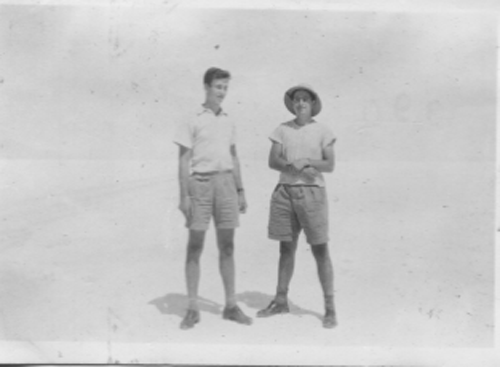
On the Salt Flats
At last we left the salt flats behind & there the land became greener & more populated. At one place we stopped & Mr. Young went out into a house. He was gone some minutes, & meanwhile we spoke to the young man, & he told us about the missionary system, how all young men are liable to be called upon to go out anywhere in the world as missionaries, & how they must go at their own expense for as long as 1 or 2 years. Mr. Devaney had told us about swimming in the great Salt Lake & we decided that it would be an interesting experience & we would like to do it. So we asked Mr. Young to put us down somewhere where we could go swimming in the Lake. He said he would & told us a lot about it. He said it was about 25% salt &, as we expected, it was very easy to float in. He warned however that the water stings when it is splashed in one's eyes, and that it is very unpleasant & dangerous to swallow the water as it is possible to choke on it.
At last we came to a beach called Black Rock Beach where he drove us in. I don't know whether we would normally have had to pay to get into the beach or not, but Mr. Young explained to the boy at the gate that we were British students & he let us through. Before he left us, Mr. Young said that he would try to arrange for us to be shown around Salt Lake City & that, after our swim & when we got to the city (we were then about 20 miles from it) we should call in at the information bureau in Temple Square & he would leave a message there for us. We thanked him & he left. At the beach there was a group of buildings - bath-houses, bar, refreshment stands, etc. We rented bath-houses for 35¢ each. Towels were provided. We wore our own swimming trunks. Where we were, there was no "beach," but only rocks. But one only had to wade out a few feet before reaching soft sand. Brian was the first to go in. The water was warm, & he found that he could float effortlessly. I photographed him floating & then he took a picture of me & then we were both in. It was a very novel experience. There was no trouble at all in staying afloat, and we tried all sorts of things. We found it slightly difficult to stand up from a floating position. But the reverse was delightfully easy. We both soon learned the stinging effect of the water on the eyes, & we both cried real salt tears. The stinging, however, does not last for long. We managed not to swallow any water. We found that when the water dries on anything, such as our bodies, it leaves a coating of salt upon it. When we finally came out, we had to take a freshwater shower to get rid of the salt.
In the Great Salt Lake
Being hungry, we had some food at the refreshment
stand before walking back onto the road. We soon got a lift with
a young man into the city, which did not seem to be as large as
I had expected it to be. Temple Square we had to reach by taking
a bus. It is the center of town, a group of buildings surrounded
by a stone wall. The largest building was the Mormon Temple, a
grey stone spired edifice into which we later found that, not
being good Mormons, we were not allowed to enter. The information
bureau was inside the museum building. There we introduced ourselves
at the desk & were taken into an office where a fairly young
well-dressed man spoke to us for some time about our travels.
He told us that we were fortunate to have met Mr. Young. Then
he said that he would like us to stay at the Temple Square Hotel
& attend an organ recital, go on a guided tour of the grounds
& then see a movie about the Mormons. He asked us to look
round the museum while he made some telephone calls. While in
his office, we met some other men.
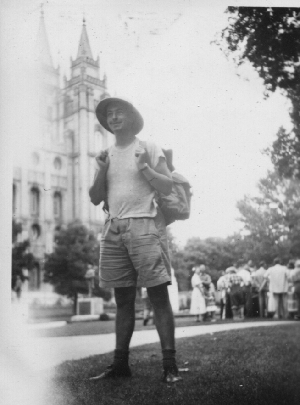
Temple Square, Salt Lake City
We felt extremely lucky. The Temple Square, we supposed, was the best hotel in town, & everything was being arranged for us. In the museum we found many things connected with Mormonism, including many relics of the early Utah pioneers. Then the man to whom we had spoken came & said that he had not been able to get us into the Temple Square Hotel as it was full, but had got us a room in the New Ute Hotel, not quite as good. He suggested we go & leave our things there & then come back for the organ recital. That is what we did. We had comfortable single beds, a sink, shower, & lavatory and we didn't have to pay for it at all. The organ recital was held in the building called the Tabernacle, a large sort of auditorium with a rounded room. The organ was a very large one. After the recital, at which there were many people besides ourselves, we went round with a crowd & a young well-spoken guide from whom we learned more about Mormonism, including the interesting facts that Mormons are supposed to give a tenth of their income to the Church & are not supposed to smoke or drink.
In the Tabernacle we saw a short demonstration of the wonderful acoustics of the building. We sat at the back & a man in front whispered & dropped pins & nails. All the sounds could be plainly heard. After the tour we sat for the movie show which was an abridged 30-minute edition of the 20th Century Fox picture "Brigham Young," starring Tyrone Power. In the Temple Square there is a monument with figures of seagulls on it . This commemorates the providential arrival of seagulls which ate the crickets which threatened to destroy the wheat-crop of the early settlers. After the show the man to whom we had spoken gave a religious address, & spoke well & sincerely. After that we left, had something to eat at a drugstore & then returned to our hotel.
Tuesday, August 21st, 1951
(written August 22nd, 1951) We slept well in our separate beds
& were up about 9:15. We checked out of the hotel & had
breakfast in a drugstore. Then we went back to the museum information
bureau, hoping to be able to thank the man to whom we had spoken
there yesterday. But he was not there & we had to come away.
During the whole of our trip many people have approached us &
asked us question about where we have come from & where we
are going. These incidents are too numerous & similar for
recording here.
From Salt Lake City we planned to go North through Idaho to Yellowstone Natl. Park before heading for New York. First, we had to get out of the city & after asking directions & after a short walk we got onto the main road going north through Ogden, Utah. While we were walking along the road a man came up to us & said he would be driving a truck up to Ogden in half an hour & would take us if we wished. We at first accepted & he pointed out the truck to us & told us to stay there & went away. We walked over to the truck, but found that there were already a woman & child in the cab & the back was entirely flat & open. So we decided to seek more comfortable transportation & asked the woman to tell the driver that we had decided not to accept his offer.
Today was to be a day of good hitch-hiking. We had barely started upon the highway when a car stopped for us, & a man & woman took us 10 miles out of the city. Then we almost immediately got another lift with a man who took us to Ogden. There at Ogden we waited only a few minutes before we received our longest lift of the day, with 2 17-yr old boys, students at the Univ. of Utah in Salt Lake City. They took us all the way (about 200 miles) from Ogden, Utah, to Idaho Falls, Idaho. We talked quite a lot with them. The Idaho landscape was partly fertile & green, & partly arid & bare. Always there were mountains in the distance.
We reached Idaho Falls well on in the afternoon & had not yet had any lunch. So before going on, we had a meal in a café & then had two more lifts in quick succession. The first was with a young man who was working on the building of a high school to the town of St. Anthony, & then we went a few miles more with a father who was taking his young son out for a drive. He took us to just past the town of Ashton. We went through some heavy rain & it was raining when we reached Ashton, so the man, not wishing to let us out in the rain, drove us a little way past. Idaho is famous for its potatoes & we had seen many earth-covered potato-storage places which looked almost like underground air-raid shelters. The man let us out at the entrance to one of these where we could shelter from the rain. We stood there for a while & it became dark. There were now few towns between us & Yellowstone & so there was not much "local" traffic. Most of the cars were tourists, and they are not so good for rides. We sang a while & finally gave up, as it was getting late, & started to walk back to town. A car stopped for us & took us into the town. There we asked for the police station, & were directed to a building in which was the local library. We asked the man there if he knew a cheap place we could stay. He said he had a friend at a hotel & phoned him & came back to us saying that we could have a room for $2. We accepted & he directed us to the Hotel Ashton where we had a room with a double bed.
Wednesday, August 22nd, 1951
(written August 23rd) We slept fairly well & were up about
8:30 at the Ashton Hotel. We had breakfast in a café next
door, & wrote a short letter to Pearl & Archie Bogat telling
them that we expected to arrive in New York about August 30th
or 31st. The man to whom we had spoken last night came into the
café for breakfast. When he had finished, he went to the
cashier & paid his own & also our bills. This was very
kind of him. We just thanked him as he was leaving.
We waited for a lift at the edge of Ashton & had not long to wait before we were picked up by a man driving a car which was pulling a small trailer, into which we put our rucksacks. This man, short, strong, slightly grey, wearing overalls, was going to where his wife & children were in S. Dakota, to bring them out to N. California to live. He used to work in a sawmill & showed us where small pieces had been cut off the end of his fingers. Now he had become a fisherman & told us how he went out in a diesel boat with nets. He had been driving without sleep, he said, since 10 A.M. yesterday. Went with him about 14 miles into Yellowstone Park to Madison Junction, where he went north & we went south. On the way we stopped twice, once at a café where our driver went inside to get a cup of coffee while we waited outside. He returned with a little gift for each of us - one of the humorous printed letters that we have seen for sale in many places. These were about Yellowstone Park & we later sent them to our families. Another time we stopped at a souvenir place which advertised a free zoo. We went inside & saw monkeys, a lynx, Gila Monster etc. It may have been free, but all over there were signs & places for contributions.
At Madison Junction we visited a small interesting
museum and then hitched on. I knew very little about Yellowstone
except that it was famous for its bears and its geysers. During
our hours in the Park, we saw both in quantity. We saw bears walking
& sitting by the roadside, & it seemed very strange to
have them roaming wild like that. People are warned that the bears
are potentially dangerous, but many people go up close to take
pictures, as I did. The bears do not look very dangerous. They
are browny-black in color.
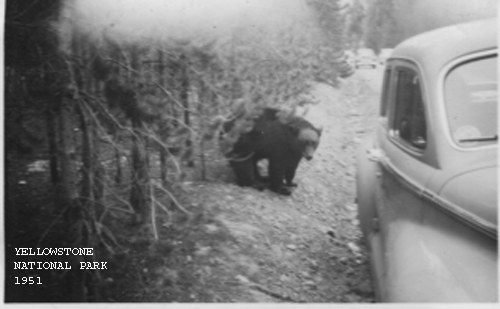
Inside the park, we saw cars from a great many
of the states & from Hawaii, Alaska, and Canada. The park
was just full of tourists, and some of the roads were busier than
in a city. Whenever we were walking about, & even when we
were eating in the cafeteria, people would come up & talk
to us & ask questions. We really attracted attention, and
the strange thing is that in England or on the Continent at comparable
beauty spots, young people like us with rucksacks & shorts
would be not at all exceptional. All the tourists seemed to have
cars, & many had cameras. The most common kind of dress for
both men & women was "jeans" (dungarees), a windbreaker,
and a small peaked cap.
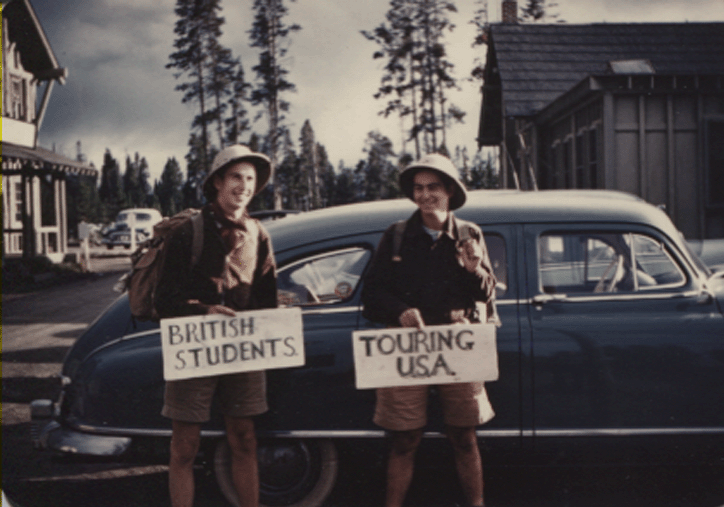
At Yellowstone National Park
From Madison Jntn., we soon got a lift, &
this time it was with a man who was the Belgian Consul in Kansas
City MO & a woman who was probably his wife. Their car was
not new, & they were not particularly well-dressed. They spoke
good American, but with accents & the man said he used to
be Belgian Consul in New York. They stopped several times at different
geysers, & we all got out to look at them. The ground around
them was a light color, & they were a very interesting &
unusual sight- holes in the ground out of which water-vapor was
rising, sometimes in large quantities so that it was like a fog.
The holes, of course, were filled with water. These people took
us down to the most famous geyser of all, "Old Faithful,"
which erupts periodically at intervals of about 55 minutes. We
waited at a distance from the crater with the crowd gathered to
watch. A ranger gave a talk on the geyser, & at last it erupted
high into the air -- water &
vapor. I took a photo of it.
We had lunch in a cafeteria there, & then got another lift, with a man, woman & boy, in a jeep. They took us about 20 miles more in the park, to another junction, where we were soon picked up by some other people, parents, a son about 20, & a boy-friend of his. They seemed very interested in us & our trip; the drove us to the cabins in the park where they asked if they could take pictures of us. We agreed & they took some color pictures of us, & also some movies. Then we had to wait a while close to where a bear was standing by the roadside, before we got our last lift of the day with a young man, a high-school teacher of Algebra, who took us all the way to the town of Thermopolis, Wyoming, out of the East entrance to the park & through Cody. We could have gone on with him to Casper, but he wouldn't have got there til midnight. We talked with him about education. The land was open & bare & soon it became dark. I saw small wild animals sometimes on the road, & once we almost hit a horse.
At last we got to Thermopolis & there we told our driver that we would like to go to the police station. He inquired at a filling station & the men there said there was no police station, but they phoned for a policeman, & he came after our driver had gone. He told us of the Park Hotel, which he said would be the best place for us to stay. He told us how to get there, but first we went to have a meal at a café. There the policeman came in & introduced us to a woman who he said owned the hotel. She drove us there, in the cab of a small truck, & we had a double bed for the night.
Thursday, August 23rd, 1951
(written August 24th) Our night was not too uncomfortable, &
we were up about 8 A.M. Usually Brian gets up first & wakes
me . When we were ready, we left the hotel, at which we had paid
$1 each. Thermopolis contains some warm mineral springs &
there are several bathing establishments where one may swim in
the water. We had decided to try one of these & went over
to a building nearby, where we paid 35¢ each, changed to
our swimming trunks in some cubicles, and went over to an outdoor
pool. We were the only people there, & that made it more enjoyable.
The water was really warm, like a warm bath, & swimming was
enjoyable. There were some inflated inner-tubes in the pool, &
we played with them. We did some diving from a board. Before getting
dressed, we went for a few minutes into the indoor pool, &
there had fun swinging on a rope out over the water. At last we
got dressed & left.
We had breakfast in the café of a hotel. We were a short way out of the town & got a lift back in with a colored man. The main road of the town was under alteration & was in very poor condition. We walked along it & were picked up after a short while by some people, a man & 2 women, who said they had seen us yesterday in Yellowstone. They took us about 140 miles to the town of Casper, Wyoming. All the Wyoming towns had a "Western" flavor to them & all the men & children seemed to wear westernized clothes - broad-brimmed hats and "jeans" (dungarees). There seemed to be a rodeo or fair going on in every town. We had lunch at a place in Casper & then got a lift to a few miles out of the town with a woman & 2 boys. Wyoming is sparsely populated, and most of the landscape is open & bare.
We had not long to wait before we got a lift with a man who worked for an oil company, & as we went through an oil-field where derricks stood on each side of the road, he explained something about them to us. He took us into the town of Glen Rock. It was raining, & we had to shelter under some trees. It was at Glen Rock that we had our longest wait of the day. While we were waiting on the road outside a house, a woman came out of the house with a camera & asked if she could take a picture of us "just for fun." We had no objection, & she got her picture. Another time, a woman drove up in a car, said she had seen us waiting, & asked if she could take us to lunch. We thanked her but explained that we had already partaken of our repast, & she left.
At last, after quite a wait, we got a lift, our last of the day, & a long one. It was with a family, a mother & father (who was driving) & two 8 & 9 year old sons who were very active & rather ugly. The 9 yr. old son, said the father, had rather defective speech because he had defective hearing. But now the hearing was cured, & the speech was improving. The father, whose name was Mr. McDonald, was a tall strong-looking man, with a fine resonant voice. He told us that he had once been a forest ranger in Yellowstone & Yosemite Parks. Now he was running some lumbering company. He told us that if we would like a job lumbering in Oregon next summer, we should write to him, & he would advance us the fare from our salary.
We drove for a long time. At one town we stopped & they treated us to drinks. I had a root beer because I wanted to try it, but I didn't like it at all. Mr. McDonald told us about how he goes hunting every year, & it made me feel that I would never want to go hunting - shooting & killing & cutting up. He told us of some fights he had been in & said he had once beat five & another time eleven men by himself. We stopped at one town to have the engine of the car attended to at a service station, & the McDonalds invited us to join them in an open-air supper. When the engine was alright we went with them to a grocery shop to buy some food there, & then we drove to a picnic-table at a nearby park. There were many foods which I did not like - salads, macaroni etc., & so when they asked me if I liked pork chops I said yes because it would otherwise be inconvenient for us all, although I never ordinarily eat ham, pork, bacon etc. Afterwards, Mr. McDonald asked us our religions & I said I was Jewish. He said I was one of 2 Jewish people he knew who would eat pork. I did not mention why I had eaten it. I also had milk, bread, soup, & cake. It became dark, & we ate by the light of the car's headlamps.
Then, not wishing to go on too late, we asked the McDonalds, who were going on further (they came from Kansas) to let us out at the town of Mitchell, Nebraska, so that we could stay there. There we said goodbye to them & asked a policeman for a cheap hotel. He directed us to one, & there we had to wait some while until the owner showed up. We each got a room with a double bed for $1 each, but nothing was very clean.
Friday, August 24th, 1951
(written Sugust 25th) Last night was the first time on our trip
that Brian & I had each a double bed. We slept well &
had breakfast in a corner café. For breakfast we often
order hotcakes or eggs.
Today was one of our worst days for distance covered, although we had 6 lifts. After breakfast, we began to walk out of Mitchell, a small town, & soon got a lift to the town of Scott's Bluff. We rode for the first time in the back of a van. The Nebraska landscape was mostly flat green farm-land, & we were close to the route of Old Oregon Trail along which the pioneers went West. From Scott's Bluff we were soon off again with a man & woman in a car some more miles to the town of Bayard. The road was following the course of the North Platte River. In these early lifts, we never had to wait more than a few minutes. From Bayard a farmer & his wife took us out into the country & left us on an open road. From there a retired farmer carried us on to a small place called Northport.
There we had quite a long wait, & while we were waiting, a man in a small truck stopped & seeing that we were British, told us that there was a woman from England living nearby & asked if we would like to meet her. We said we would & he drove us a little way along a side-road to a house where a small woman came out. She was a war bride & came from the City of London. She had been living over here about 5 years & had little accent left. We talked a short while with her, then climbed back into the truck & the man started to drive us back onto the main road.
But then Brian began to have one of the spontaneous nose-bleeds which he has occasionally. They are not serious, but come suddenly, & the blood often soils his clothes. The man with whom we were said that he was a non-practicing chiropractor (something like an osteopath) & began to manipulate Brian's neck. After a while the bleeding stopped & the man took us back to a house for Brian to wash up. Then he drove us back to the main road, & after a while we got a lift with a man, a salesman, who took us to the town of Broadwater where he treated us to lunch in a café. He said that the money came off his expense allowance.
It was Friday today, & the weekly article for the "Edgware Post" had to be written & sent off. I had written part of it last night, & we now had to spend about 3 hours getting it finished. It is always I who write the final article, & the articles are certainly much more my work than Brian's. I try to do as much of them as I can. I write some completely on my own & Brian does some in rough which I change considerably & add to when I write the final version. This week's article covered some of our experiences in Los Angeles & went on til we left San Francisco. It was not until about 5 P.M. that we finally left the café, posted the letter, & began hitch-hiking again. The first position which we took up was too near a dead turtle lying on the roadway for my liking & so we went on a bit further.
The lift we finally got proved to be our first lift in America in a large truck, or rather in 2 large trucks, for this is what happened: 2 trucks in succession passed us by & then after a while one of them returned to us & took us both into the cab. We loaded our luggage on the back. Then we reached the place where the 1st truck was parked & I went to ride with the driver of that one while Brian stayed in the other one. The driver I rode with had been in England during the war (so many men we meet have been!) & I talked with him about it. Talking was difficult because the engine made such a noise. We were going to the town of Ogallola which was at the junction of the road we were on & highway 30, which we intended to follow east. But when we had reached to within a few miles of the town, my driver noticed that he could not see the other truck following behind. So we had to go back a way til we found Brian's truck parked by the roadside. It had run out of gas. What had to be done was that Brian & I rode the remaining distance on the back of the truck with gas with our packs & the two men rode in the cab. They were later to return to the parked truck.
At Ogallala Brian & I had a meal in an insect-ridden café, then stood in the dark on the insect-ridden road trying to get a lift. But it was to no avail & we had to walk back into town, find a policeman, & ask him where would be a reasonable place to stay. He suggested Scott's Hotel & we went there & had to wait about an hour reading magazines before someone came & we could get a room. We had a double bed for $1.50 each.
Saturday, August 25th, 1951
(written August 26th) I slept quite well. This morning we were
up fairly early to continue our journey east. We are getting into
a sort of routine now, of getting up, hitching & stopping
for meals, finding somewhere to sleep, sleeping, etc. We always
have good meals, but we try to avoid expensive dishes. After breakfast
this morning, we were off again & after a very short wait
got a long lift of 190 miles with a man from Texas on holiday.
He talked with us about guns & snakes & Texas. He had
a real Western drawl. He stopped once or twice & treated us
to tea & cokes. He took us to the town of Grand Island, Nebraska.
We were following a bend in the North Platte River. We had lunch
in a café at Grand Island & then had some difficulty
in getting a lift out. The road was hot & insecty & we
walked along it a little way. We noticed by the roadside many
dead butterflies & birds. At last, after we had been waiting
almost an hour, we got another long lift, with another single
man, to the town of Fremont, Nebraska. It was all farmland that
we were passing through & he told us how rich some farmers
were & also talked about cars & car-driving.
At Fremont, our driver turned off to go north, but before he left us, he drove us to a drive-in restaurant & treated us to hamburgers & chocolate malted milk. It was the first time that I had had a "malt" & I liked it & found it very filling. Brian & I also tried out a new soft drink called "Squirt," a fizzy grapefruit drink, which we thought fair. At Fremont it was already dark & we have found it very difficult to get a lift in America at night. We stood for a while, however, by the roadside & sang songs, & at last we did get a lift, a few miles more with 2 boys & a girl to the small town of Arlington Nebraska. It was the usual kind of small town, & as such, had no police station. We asked a group of men where the policeman (whose name was Ed) could be found. They knew he was somewhere around, but not just where, so we went first to have a meal in an eating place. As usual, everyone there looked at us as we walked in & took our seats. After a while, many children entered the place, & it became quite crowded, although it was rather late for children to be up. Some of the children stood & looked at us for a while. Most of them were wearing jeans. One little boy in glasses & a brightly-striped sweater just stared and stared. When we left, too, some of them seemed to come out behind us.
We finally got in touch with the policeman & he could only suggest one rooming house which he phoned up for us & then drove us round there. An old woman showed us our room. We paid $1.50 each. In the room were some magazines including some National Geographics of which none was newer than 1938. The woman asked us not to use too much water as it drained not into a sewer, but into a cesspool. The sink was muddy & small.
Sunday, August 26, 1951
(written Aug. 27th) Today was a day of traveling, almost all in
one car, & rather a dull day, for there was little incident.
We had breakfast in Arlington at the same place we had eaten last
night & were on the road by about 10:30. It was a sunny day
& we soon got a lift of just 2 miles down the road in a car
with a man & two boys. The man worked at some large plant
nurseries there. After that, we had considerable wait before we
got our next lift, our 99th, which was to take us over 300 miles,
to the town of Clinton, Iowa. It was with a woman & two men
from Chicago who were on their way back from holiday. I think
they were husband, wife, & wife's brother. We didn't talk
much to them & they had the radio on most of the time, listening
to baseball games which after a while became quite tedious. We
had a late lunch at one town & they treated us once to soft
drinks. We drove for many hours. The landscape was not very interesting
& we were crowded close together in the back with our luggage.
Anyway, we made good distance, & about 9:30 P.M. we arrived in Clinton, where they were staying the night. Clinton is right on the Mississippi River, & we walked across & sang "Old Man River" & other songs as we went. The river looked dark & mysterious below. On the other side was the state of Illinois, so we never stayed a night in Iowa through which we had been driving all day. At the other end of the bridge was a toll station, & we each had to put a nickel into a milk bottle on the end of a pole. Across the river was the small town of Fulton, Illinois, & after we had had a meal (in Clinton) we asked directions to the police station & outside it we spoke to a policeman in a car about the most reasonable place to sleep. He could only suggest a certain place with tourist rooms, which he phoned first to see if there was room. There was, & he took us round there in his car. Our room with a double bed cost $1.50 each. It was very clean & neat & there were good supplies of towels & soap. The bathroom was equally satisfactory, & there was a shower which we both used. The room was furnished with some religious tracts, including one for temperance, telling about the rats etc. which have been found in beer vats.
Monday, August 27th, 1951
(written August 28th) It was a full day today, and one in which
we had a record number of lifts - ten. We traveled too a good
distance of about 480 miles, & were in 3 different states.
Our best lift was the last one.
We slept well last night, & had to walk back a little way into Fulton to get something to eat. Many times we are asked "What do the people in England think about the Korean situation?" & it is difficult to answer. After a breakfast in which I had hotcakes, eggs, & tea, we set out on our way. Walking along the main road out of the town, we were soon given a short lift to a road junction by a man in a Buick convertible. Getting lifts has been pretty easy lately. Sometimes we get them almost immediately, sometimes after a short wait. Rarely have we to wait over 45 minutes.
Since we have had quite enough money to meet our expenses of food and lodgings, we have taken to purchasing occasional little luxuries like bars of candy or soft drinks. We never stint on meals, though I usually seem to have more than Brian. I feel sure that I have put on weight.
From the junction, we got a lift with parents & a young son to Rock Fall. We were going across Illinois on Highway No. 30. Our next lift followed very soon. Sometimes cars apparently pass us by & then we see they have stopped for us further down, or sometimes they even turn around & come back to us. This lift was an interesting one because it was with a middle aged couple on holiday from Toronto, Ontario, Canada. They lived on Gerard somewhere, & had been over to Victoria British Columbia. We talked a lot with them, mostly I, & of course told them about my connections with Canada. The wife had come originally from England & the husband from Scotland. He had seen much action with the Canadian troops during 1st World War & told us a lot about it. They left us close to the town of Aurora. We were then fairly near Chicago, but our road this time went south of the city.
We had lunch at a cafe where we found ourselves, & I had fried chicken. We spoke to a waitress who said she was a displaced person from Estonia & had been in the U.S. about 18 months now. She spoke fairly good English, & said she was soon to leave her job & join the Army as a teacher of the Russian & Estonian languages. // I omitted to mention that the Canadian woman, Mrs. Packman, took some photographs of us & we gave our addresses & she said she would send us the prints. That was about the 4th time we had had pictures taken in such a way.// After lunch, a woman with 2 boys drove us to beside a golf course just outside of Aurora, and there we had to wait about ½ hour before a loud-voiced man took us on to the town of Joliet. He said he owned a farm & a trailer sales place nearby.
Carrying our luggage in the cars is done in a variety of ways. Our favorite lift is in a car with just the driver & a little luggage of his own. Then we can put our rucksacks in the back seats & sit up front with the driver. I usually like sitting at the window. The worst kind of position is when the car has several people in it & we have to hold our rucksacks on our laps. Since the cars are larger here, this is less often the case than in England & Europe.
The air at Joliet was very humid, & we felt hot & uncomfortable. We had quite a walk & over a bridge to get out of the town, & on the way paused for an orangeade. At last we got a lift, & coincidentally it was very much like our last lift with 2 trucks on August 24th. 2 trucks of the same company stopped for us & I got in the rear one, Brian in the front. They took us that way a few miles over the border into the state of Indiana. My driver was not very talkative, but Brian's offered him $2, which, as usual, he refused. Then another single man took us a few more miles to Valparaiso, Indiana, and with 2 boys in another lift, we went on to Wenotah.
It was there that we got our last, longest, & best lift of all, with a fairly young man named Mr. Kneif who was from Milwaukee, Wisconsin. He was a traveling salesman, selling air-cooled engines for the Wisconsin Motor Corporation, & was going to Columbus, Ohio, for the State Fair there. He was a member of the Lutheran Church & told us much about it. He was particularly interested in church activities as he was one of the few lay members of the policy-making board of the Church. He was a good talker, intelligent, friendly, & very interesting, & I really enjoyed the ride with him, which took us eventually to the town of Marion, Ohio. I learned much about his job, his church, & his life, & only wish I could write in detail all about our conversations. We talked about politics & war & peace. He took the side of war if need be, & I spoke up for peace & pacifism. He said he did not believe in the theory of evolution, but we didn't talk much about that. He seemed to have a good job, had all expenses paid, was using company's car, & often traveled by air. We rode on for many hours. It was so interesting listening to him that that ride did not seem long. We stopped at a restaurant where Mr. Knief treated us to a meal. I had hamburger steak.
It was quite late at night (I am reluctant again to mention times because they change on our way across the country) when we reached Marion, Ohio. We could have gone on to Columbus, but that would not have been directly on our way, so Mr. Kneif kindly waited outside a police station which we made enquiries inside. Then he drove us to 2 of the hotels to which we were referred. The first, the Milner, was full, but at the Snyder we got a room with 2 beds for $1.75 each. So we said goodbye to Mr. Kneif & he gave me his address. In our room there was a double & a single bed. We tossed, & Brian won the double. But mine had a better mattress.
Tuesday, August 28th, 1951
(written August 29th) We had 4 lifts today, & traveled from
Marion, Ohio, to Pittsburgh, Pennsylvania. We slept comfortably
& rather later than usual because we had been up later than
usual. We had breakfast in a drugstore & then started to walk
out. The typical American residential street is tree-lined &
has white wooden houses.
We have several different ways of hitch-hiking. Sometimes we just walk along the road with our back to the traffic, signaling with our thumbs. Sometimes we sort of walk backwards facing the cars, holding the sign & hitching. But most frequently we just take off our rucksacks & stand beside them with our "British Students" sign.
This morning we were walking along when a woman alone in a car stopped for us. This was just about the 1st time that we had a lift with a woman alone. She was early-middle-aged & said she could take us out of the town. But after we had gone a little way, she suggested that we might like to see the Tomb of President Harding, who had lived in Marion. We agreed, & she drove us there, talking meanwhile & telling us about the President, what a kind & good man he had been. We looked at the tomb for a little while. It was a roofless circle of pillars, with the graves of Harding & his wife within. When we drove away, the woman told us that she was related to Pres. Harding's 2nd wife, whose name was De Wolfe. She was some sort of a cousin. She told us quite a bit about the President, who had been in office after Wilson & before Coolidge.
She told us too about her son, & his adventures
on holiday with friends, going down the Grand Canyon. She drove
us to outside Pres. Harding's old home, which was now a museum,
& offered to pay our 25¢ admissions, but we were in a
hurry & couldn't accept, so she drove us out to the edge of
town, & there we soon got a lift with 3 middle-aged women
who took us to Crestline, Ohio, & put us again at the far
edge of town. There we waited a while & had a soft drink in
a nearby diner, & finally got a lift with a young couple who
came from Massachusetts & were on holiday, driving & camping
out at nights. They were well loaded with luggage, & we had
to take turns sitting in a cramped
space in back while the other sat in front. The woman was a kindergarten
teacher, but, as usual, she didn't seem much like a teacher. The
man was studying engineering at the Mass. Institute of Technology.
They drove us for several hours across Ohio. We also went into
a small part of the state of West Virginia, about the 22nd state
we had been in.
We crossed the Ohio River into W.Virginia & left our people on the other side, at Chester. It was by then late afternoon, & we had had a late breakfast, but no lunch. So we had a meal in a café before going on. Returning to the road, we soon received our last & most enjoyable ride of the day. We were picked up by 3 boys riding in the front seat of an open convertible. The back seat was full of luggage & covered with the car-cover, so we had to sit on top of that with our rucksacks. We were quite safe, & the boys in front held on to our rucksack straps, while we held on to the rucksacks. The boys' names were Tom, Bob, & Fred, & they were 17 & 18 yrs. Old. One of them was born in London, Ontario, Canada. They had been on tour, & visited many of the places we had been to. They lived in Philadelphia, & were making for Pittsburgh, Pennsylvania, this evening.
The miles we rode with them were enjoyable. One of the boys was plump, had a loud voice, & talked a lot. He called at all the girls we passed. He told us that his father was chairman of the American Socialist Party, & he was glad to hear that we were on the whole in favor of socialized medicine. Two of the boys were going to Harvard & Yale this September. One of the boys had an Aunt who lived in Pittsburgh & he told us that she was away but that she had given him permission to use her apt. If they could get into the apt., they were going to stay the night there, & they said we could too.
At last we arrived in Pittsburgh, where we noticed that the air was rather smoky. Riding in the back of an open convertible made us feel rather like celebrities entering a town, & for fun I kept taking off my hat to the people as we passed by. The address of the aunt was 3596 Beachwood Blvd., & the boys had considerable trouble finding it. We had to drive around quite a lot before they found it, then they found that the janitor didn't have the key, so it was no good. They were very friendly, & we asked them to take us to a police station. They eventually asked a motorcycle policeman the way; he took one look at us & said "Follow me!" & so we drove off, & with a "police escort," Brian & I felt even more like important visitors. The cop led us to a p. station, & there we thanked the boys & bade them farewell. We went inside; there were many policemen about, & we as usual asked the man at the desk about cheap accommodation, explaining our position. He thought for a while, but could eventually suggest only a hotel where it would cost us $2 each.
One policeman took us round to the cell block & tried to persuade us that we would be comfortable on the hard wooden beds. But they did not look enjoyable & so we decided to go to the $2 place, which was the Hotel Moritz. The man at the desk gave us written directions how to get there. We had to take a streetcar & while waiting for one we were joined by a policeman just coming off duty. He talked with us & told us that he had had an Aunt in Wallasey, Cheshire, but had not heard from her since about 1942. His letters had been returned by the Post Office. I looked up Wallasey on a road-map of Britain & found it near Birkenhead. I said if he would give me the address, I would try to look up his aunt if I were ever round that way. He said he would leave the address at our hotel.
For $2 each at the St. Moritz we got quite a good room, with a bathroom & shower & good furniture. But the neighborhood was not good. Our window looked out onto Collins St. (I think) & while we were getting ready we heard noises in the street of a child crying. We looked out, & saw 2 men lying on the sidewalk some way down, apparently fighting (one seemed to be holding the other) while a crowd was beginning to gather. Then some police arrived. I went downstairs to see what was going on, & saw two policemen leading a man away into their car. I asked a man what had happened, & he said that a man who was a ---- maniac [sic] had been beating his child & terrifying her, & was, I gathered, stopped by another man, until the police arrived. Afterwards we saw several more policemen walking in pairs on the street below.
Wednesday, August 29th, 1951
(Written August 30th) Today we had only 2 lifts, but the 2nd one
proved to be a very fortunate one for us. We slept well last night,
& this morning while we were getting ready, a man from the
hotel came up & gave us two envelopes. They were from Sergeant
Connell, the policeman to whom we spoke last night. One envelope,
carrying the message "For a favor promised," contained
4 dollar bills, the price of our hotel. The sergeant had paid
our hotel bill! The second envelope contained a short letter to
us which gave Mr. Connell's address & the last known address
of his Aunt in Wallasey. This was a very kind act & we wanted
to thank Mr. Connell. We tried to phone him, but couldn't get
on & just had to phone & leave a message of thanks at
the police station. [Months later, back in England, I made a project
of trying to find that lady - which turned into quite an adventure
in itself.]
We had breakfast in a café. A man working there spoke to us, told us he was a soldier in England during the war. He said he married an English girl, brought her out here, paid for her to take a trip back to England once, & then she deserted him & went back home. He was now married again. Many people, usually men, often come up to us, seeing that we are English, & say that they came from England 30 or 40 years ago.
We had to get out of Pittsburgh, & after asking directions, we were advised to take a certain streetcar. We wanted to get on the famous road known as the Pennsylvania Turnpike, which extends to Pittsburgh. The streetcar took us out to where the road was more open, & there we got a lift of a few miles with a 17-yr. Old boy. Then we had a considerable wait, & had to walk some distance before at last we got our good lift. It was with a Mr. Buhl, who lived just outside of Pittsburgh. He was a traveling salesman selling coin-operated parking meters to local authorities. He was a grey-haired man in his 60's, very fond of talking, especially about politics. He seemed concerned that our rucksacks would damage the interior of his car, & made us put them down very carefully. The car was a black Oldsmobile, & we sat in the front with him. We had gone only a little way when he pulled into a restaurant, & we got out & went in for lunch. I had a hot chicken sandwich with potatoes & gravy. We paid our own bills. After the meal, we sat & talked for a while. Mr. Buhl was a Republican, staunch defender of free enterprise, and, like almost everyone else we have met, antagonistic to President Truman. He was interested in our views on Socialism & defense.
At last we left the restaurant, & soon came to the place where the Turnpike began. There was a sort of toll-gate, & every driver going on the Turnpike is given a ticket punched at the time & place he came on. At the other end, payment has to be made, at the price of about 1¢ per mile. Mr. Buhl was going on business to Allentown, Pennsylvania, & so we went along the Turnpike, which is between 200 & 300 miles long, from Pittsburgh to Harrisburg. It was a very fine road, with 2 lanes of traffic in each direction, separated by a grass-filled "island" running down the middle. The slow traffic like trucks is supposed to keep to the right & be passed on the left. Often we see trucks with signs on their backs telling of the danger of passing on the right, e.g.: <SAFE SIDE SUICIDE> <ZOOM DOOM> .
The road, though going through very hilly country, was fairly level. There were several long tunnels going through the mountains. The speed limit on the Turnpike is 70 M.P.H., but many cars go about 85 M.P.H. (speed limits seem always to be ignored in America.) We often went above 85, & for a time we were going at over 100 M.P.H. But Mr. Buhl was a good driver. He told us he sold on commission, & had to work hard, but made more money than by salary. The Turnpike has no towns along it, no intersections, & no traffic lights, so one can go very fast for considerable distances. But we had to slow up for construction work or tunnels, or when we got stuck behind another car. We heard that, despite the fine-ness of the road, there were many accidents & fatalities upon it, probably because people went fast who were unused to going at such high speeds. At intervals along the road, there were gas stations & restaurants, & we stopped at one called the MIDWAY, supposedly half-way along the road, where Mr. Buhl treated us each to a chocolate malted milk, and I sent a postcard home.
We came off the Turnpike at Harrisburg, & there Mr. Buhl treated us to dinner in a restaurant. I had roast beef, potatoes, beans, chocolate, milk, cherry pie. Again we stayed talking at our table for some while, & it was about dark when we left. Mr. Buhl said he would like us to stay at his expense at the Allentown Hotel where he would be staying. We thanked him & accepted. The ride to Allentown seemed quite long, although we drove at a good speed. At one town, Mr. Buhl stopped & demonstrated to us how the parking meters worked. He told us quite a lot about himself, how he had lost everything he had in the 1929 stock exchange crash, & had gradually recovered. He was always telling us about the good things that private enterprise had done for America.
At last we reached Allentown & we found that Mr. Buhl was staying at the Hotel Americus, the biggest & best hotel in town. It was a really good place there, & he took a room with twin beds for us for $8. This was the most expensive accommodation that we had had in America. The people at the hotel desk heard our story & phoned a local paper, which soon sent around 2 people, a young boy reporter about our age & a man photographer.. They first interviewed us in detail, & then the man photographed us wearing our hats & rucksacks & holding our signs. They said it would be in tomorrow's paper, & I asked them to send on a copy & the photograph to my address.
Before we went to bed, Mr. Buhl took us to a coffee-shop across the street for a drink. I had chocolate milk. Then we said goodnight & came up to our room on the 10th floor of the 11-story building. It was quite a good room, & there was a good view. The bathroom has a corkscrew on the door, & on one wall there was a container full of Kleenexes.
Thursday, August 30th 1951
(Written August 31st, 1951) Today at last we reached New York
City. Our sleep last night was comfortable. Mr. Buhl had asked
us to meet him in the hotel lobby at 8:45 A.M. & we requested
the desk to ring & wake us at 8 A.M. So we were up at 8 &
down at 8:45 to meet Mr. Buhl. We bought copies of the Allentown
"Morning Call," but could find no mention of us &
supposed that we would be in the evening edition. Mr. Buhl took
us to breakfast in the hotel dining-room, & I had hotcakes,
eggs, orange juice, & chocolate milk. I took a great liking
to chocolate milk in Los Angeles because I had it in cartons at
Uncle Marsh's every day. Mr. Buhl told us how he had once, early
in the century begun a ranch in Texas, but had had to give it
up for some reason when his wife's mother died. Then after breakfast
when we were all ready, we went to his car & he drove us to
the outskirts of the city. We bade him goodbye & promised
to write. He had been extremely kind & generous.
We felt sure that we would reach New York today. We soon got a lift with a man going to Easton. He told us that he was a retired army colonel & had been in Britain during the war in charge of supplies coming in at Cardiff & Swansea & some other towns. He had been on a building which was bombed; 2 men with him had been killed & he had been deafened. This had caused him to be in hospital (Walter Reed Hospital, Washington) for some time. He had now almost recovered, but was till a little hard of hearing. When we were about to leave him, he offered us each a dollar bill, but we as usual declined.
We stopped in a drug-store in Easton to have our morning soft drink, this time a glass of ginger ale. Then we walked out of the town a little way on the road to New York, & soon got a lift with a man born in Canada but living in Pennsylvania. His job had to do with the purchasing & obtaining of land for new state roads. He had to assess the value of the land. He was going north, but was in no hurry, & took us a few miles out of his way. Then we had a lift to Somerville, New Jersey, with a man who worked as a ticket clerk on a railroad. He had been with the American troops in France during the First World War & told us about his experiences there, particularly about the poison gases which were used.
At Somerville, the cars were going pretty fast, but it wasn't long before we had a lift in a Buick convertible with a man who spoke fast & replied to everything we said with "Fine!" "Good!" or "Swell!" He told us he thought there was little consideration for others in the east, & people were less friendly & courteous. I disagree with this myself. Many people have told us that the people in one part of the country are more friendly than those in another, but their statements as to regions often contradict each other, and I find no such differences in all my travels. The man took us to near Newark, New Jersey, where we had first started hitch-hiking on July 3rd, but we didn't go to the same place.
We had a considerable wait on the very busy highway there, before at last we received a lift to New York, our last lift in the United States, and the 120th of our trip. It was with a Catholic clergyman, who took us through the industrial New Jersey region & under [sic] the long Holland Tunnel by which we had come under the Hudson River out of New York. He left us at the New York end of the tunnel, and at last our trip had been completed. We had covered by hitch-hiking probably between 7000 & 8000 miles in the U.S. [and Canada.] We were very hungry & went into a cafeteria, where we first went to a phone booth & I phoned Pearl & Archie in Brooklyn. I had written to them several times & in my last letter had said we expected to reach N.Y. probably on August 30th or 31st. Pearl answered & right away knew it was me. I said we would be coming over after we had had lunch.
We ate in the cafeteria, & I had a very good meal of roast beef, potatoes, beans, fruit salad, bread & butter, & chocolate milk. It cost $1.45. We knew how to get to 1075 Utica Avenue, Brooklyn, & had no trouble on the subway or the bus. It was about 3 P.M. when we at last arrived at Pearl's beauty salon, saw Archie downstairs & Pearl upstairs in the apartment. I'm afraid I would have liked to rest & relax, & was rather irritated by the questioning with which we were plied. Archie can be a very dull man, and his constant talking, plus that of Pearl did annoy me, especially when I was trying to read some letters from Mummy which had come here. There was a letter too from Uncle Marsh. He said that he had received from the TV people the government bond which we had won on the Bill Gwinn Show, but that he was going to use it to pay for repairing a lamp which I had accidentally knocked over, & his typewriter which we had slightly broken. "I know," he said "that you will not mind this." We do mind, but there is nothing that we can do about it. It does not seem very fair, but Uncle Marsh did a lot for us anyway. He said that he had heard nothing about the radio which we were supposed to win as well.
Archie told us that there were two large packages waiting for us downstairs. We were expecting to receive 2 Mixmasters from Mr. Leventhall in Los Angeles, who had promised that he would send us one each to this address. And sure enough, that is what they were, in 2 large cardboard boxes. We brought them upstairs to unpack them. We found them extremely well wrapped, each part in a separate cardboard station [sic], & there was much cardboard, paper & string lying about on the floor by the time we had them all unpacked. The Mixmasters are very good machines & Pearl says that they cost $46 each & are the best make. Each time I think about Mr. Leventhall giving them to us I am astonished anew. It is really an amazing gift. The postage alone on each parcel cost over $1. We are going to try to pack the machines in pieces in our rucksacks. We know that it is illegal to take them into England without paying duty, & only hope that we get by the customs.
We had supper here & in the evening Pearl & Archie's daughter Reggie [Regina] & her husband Lou came over here. They are interested in poetry & philosophy, & we talked with them for a while about a new philosophy which they are studying called Aesthetic Realism. Reggie read us 2 poems written by the founder of A.R., a Mr. [Eli] Siegel. One was called "Hot Afternoons Have Been in Montana." They were in the modern rhymeless rhythmless vein. Pearl & Archie's other daughter & son-in-law, Gert & Sam, are now in Europe on holiday. We did not get to bed until late. I phoned the N.Y. Herald Tribune asking if they would be interested in our story. They said they would send a reporter round tomorrow at 5 P.M
Friday, August 31, 1951
(written in the air, Sept. 1st, 1951) Today was our last full
day in America. I forgot to mention an important thing yesterday.
We received identical printed letters from the National Union
of Students telling us about the return flight on Sept. 1st. In
the letters, it said that we should meet at a certain hotel in
New York & would have to pay $1.25 transport to the airport.
But Archie said that he would drive us there, so I phoned up a
Mr. Harrison whose address was on the form, & he said that
that would be alright & that we could go straight to the airport,
but should be there at 11:45 A.M. The plane, he said, would leave
about 1 P.M. Also on the form it said that we would have to obtain
certificates showing that we owed no taxes in the U.S. So today
we had to go down to some income-tax department at 292 Madison
Avenue & take our passports to get the certificates. We went
by bus & subway, & I took writing materials, hoping to
be able to finish the "Edgware Post" article which should
have been sent in today.
In the office, there were many people waiting in chairs, but they were moving up steadily. Brian was hungry, so he went out to have lunch at a drugstore while I waited & kept his place & tried to write. He came back in good time, & it did not seem very long before we were seen to. There was very little to be done. All we had to do was show our passports & sign a form, & the certificates were given to us. I still had much writing to do & hadn't had lunch yet; the reporters from the "Herald Tribune" were supposed to come to our place at 5 P.M., so I arranged to meet Brian back at 1075 Utica Ave. at 5 P.M. so that I could eat & then find somewhere to write. I had lunch of a hamburger, potato chips, orangeade & cherry pie in the Walgreen's drugstore where Brian had eaten, but when I had finished, I decided that, as we would be leaving by air tomorrow, it would be no quicker to write the article today & post it this evening than to write it tomorrow on the plane & deliver it in person.
So I did not write any more, but looked around some bookstands for a while & then went to the famous New York Grand Central Station which was nearby and looked around there & took a photograph. I arrived back at Archie's just about the same time Brian did, & Pearl & Archie took some photographs of us in front of their shop. Then we went upstairs to pack our rucksacks & wait for the reporters. But the reporters never showed up. I later phoned the newspaper & the man there said that they did not have enough staff to cover the story, so we had to give up the idea.
Packing was quite a job for us as we each had a Mixmaster (see yesterday) to conceal inside our rucksacks. We wrapped each part carefully in clothes & stuffed things all around them to make the rucksacks look as unsuspicious as possible. We managed to get everything packed, but the rucksacks are now heavier than they have ever been before. Pearl prepared us a dinner of steak and roast potatoes. Then we watched TV for a while. Before I came back to America, I was largely in favor or commercial broadcasting, but now I have changed my mind. The standards are much too low & there is far too much advertising. But I can still enjoy watching TV here & listening to radio. There is still some enjoyable light entertainment to be had. I particularly liked this evening a TV program of "The Quiz Kids" which we used to listen to when we lived in Washington. The children are sometimes astonishingly clever. The oldest boy on the program was Joel Kupperman, who used to be the youngest when we were here.
About 9:30 some company arrived. I am not a very family conscious person & don't know who exactly they were, but I know there was the mother of Ruth Bush who we know in Edgware, and Anna Saul & her husband, old friends of Mummy, & Henry, some relation of Mummy's & people who I believe were his wife & 2 children. Also there was another man who said he knew my mother. We sat & talked & ate ice cream & at last said goodbye. Late tonight I wrote a short letter to the Leventhalls in Los Angeles, telling them that we had received the Mix-masters.
Saturday September 1st, 1951
At last I am bringing this diary up to date & am making an
entry which is not a day late. As I write, I am sitting next to
Brian, who is about to go to sleep. We are in the Skymaster airplane,
out over the Atlantic Ocean. My watch says 12 midnight. That is
Newfoundland time. We left Newfoundland some time ago. I am bending
over a fold-out table. Almost all the lights in the plane except
mine are out, & people are getting to sleep. The sound of
the plane is like the sound of a very loud rush of wind. And so
we are on our way back to Prestwick.
I hardly slept at all last night. It was very hot & humid, but worst of all, I had several mosquito bites which were excessively irritating. It was a miserable night. This morning I was up at 9:30. Everything was ready. Lou came round to say goodbye to us. We had good breakfasts & were all set by 11 o'clock. We said goodbye to Pearl. She was very hospitable, but somehow I was glad to come away. She like Archie could be very aggravating. But we were to have more of Archie before we left. He took us in his car, & on the way to the airport through Bell Harbor & Rockaway, the resorts on Long Island, he kept talking & talking in his monotonous voice, saying useless things. My family with me [sic]were at Bell Harbor on holiday in 1945 at the time when the war ended, but Archie didn't take us through any parts that I recognized. There was a lot of traffic on the highways, & we didn't reach the Idlewild airport until about noon. But that didn't matter. He left us there & we walked in. I began to feel just a little excited. We found our way to the KLM desk and showed our passports & tickets & had our rucksacks weighed & taken away. As far as they & the Mixmasters are concerned, we can do nothing but hope for the best. If all goes well, Mummy & Mrs. Richmond will get a lovely surprise.
Then we waited on seats there, & a boy came up to talk to us who, it seemed, had been doing better than us in some ways. With 4 or 5 other British boys ranging ages from about 17 to 21, he had been on an exchange tour organized by the English-Speaking Union. They had been chosen from many hundreds of applicants & had been going on a free organized tour of the United States, traveling everywhere by air, & being treated everywhere, it seemed, like celebrities. They had done many things & met many important people.
There was much less formality in leaving New York than in leaving Prestwick, & things went much smoother. At about 1:30 P.M. we were summoned to the plane, had only to show our passports, & were soon climbing into the plane. At first things look bad, for we were at the end of the people coming aboard, & it looked like we would get bad seats & have to sit separately. But even then luck was with us. There is a semi-partitioned section at the back of the plane which is really supposed to be for the crew. We told an officer that we couldn't find any seats together, so he put us in 2 seats together in the crew compartment. We are lucky because this is a sort of "private" section. We have a small round window. Opposite us are sitting 2 young English clergymen, & across the aisle are 3 members of the crew. We have a toilet which the other passengers do not have. Our seats are the fold-back kind, but they don't have much room to fold back.
On this return flight, we make only one stop, which we have already done & so the next stop will be Prestwick. The plane is now bumping more than I have known it to do before, & it's difficult to write. Flying time from Gander to Prestwick is supposed to be 10 hours. At Gander it was just as when we had come over. We went into the same terminus & had a free meal at the same place there. It has been uneventful. I sent a p. card from Gander. At Idlewild Brian & I each bought a 26¢ pocket book. I bought "Believe It Or Not" by Ripley. He bought "Dialogues of Plato."
And now I need some rest & sleep, so goodnight.
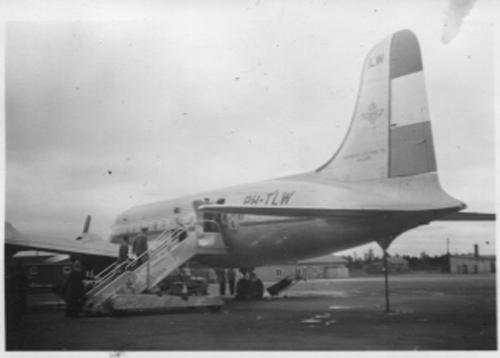
Our plane during stop at Gander, Newfoundland
Inside the plane.
Sunday, September 2nd, 1951
(written at home, Sept. 3rd, 1951) I got a few hours' sleep, was
up early on the plane, & did some more writing for the "Edgware
Post." The trip passed smoothly and fairly uneventfully.
Coming back across the Atlantic, we lost 5 hours. The whole flight
took about 17 ¾ hrs. Our outgoing flight was 22 hours.
When we arrived over land, the sun was shining & we could
clearly see all the landscape. It looked beautiful.
At last we touched safely down, & were
back in Britain. It felt cool at the airport. Later in the day
it rained quite a lot. We had to go into a waiting room, then
had our passports quickly looked over, & then the moment came
- when we came before the customs with our rucksacks, each of
which contained in pieces a valuable Mixmaster. But luck, as always,
was with us. The man merely presented us with the card which informed
us that smuggling is a serious offense & asked if we had anything
to declare, any cigarettes? -- nylons? We replied that we had
nothing & he put the red chalk-mark on our luggage & we
were free with our Mixmasters. We went into the terminus, &
I was given a letter from Mummy containing £3, which I didn't
need. We had our photographs taken at the airport at the same
place where we had them taken going out. Then I telephoned home
& spoke to Mummy. She & Brian urged me to go home by train
or coach, but I much preferred to hitch-hike, & I eventually
persuaded Brian to do so.
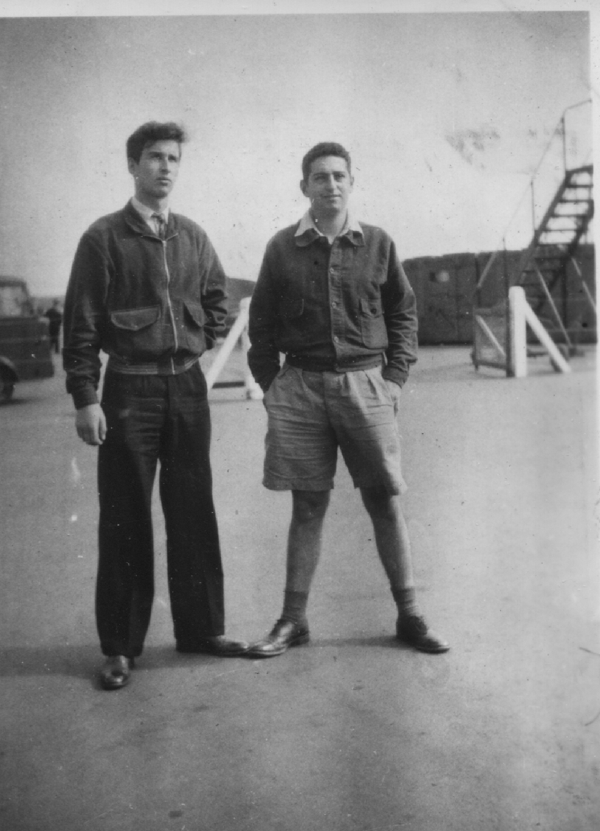
At Prestwick Airport, September 2, 1951
I told Mummy that we would be home sometime tomorrow. We left the airport with our heavy rucksacks, & decided to take the quickest route home, the one by which we had come up: Prestwick, Carlisle, Penrith-Scotch Corner, then down the Great North Road to London. To get onto the main road for Carlisle, we took a bus into Ayr and then another one to the village of Cumnock. After 2 months in America, the small & old cars of Britain seemed strange to us. So did the dress of the people. It was strange riding in a big bus and using English money again.
Our first lift in Scotland was in a comfortable private car with a man who was a strong advocate of Scottish "Home Rule." He took us to Dumphries, where we had stayed a night in the police station 2 months before. We called in at the police station just for fun, & spoke to the desk sergeant. We had had breakfast on the plane, but were now hungry & went into a cinema café. Only tea was being served, & we soon missed the American cafes & food. I was obliged to have a piece of fish, bread & butter (not nearly as good as American), and tea & cake. It was all very poor & cost us each 4/6.
We walked out of Dumphries, & had to wait a long while for our next lift. During this time I began telling Brian a story, making it up as I went along. At last we had a lift with 2 men, one young, one old, in a small car which never did over 35 M.P.H. They put us down before the town of Annan, & again we had some wait. Then the same 2 men came by & took us up again, to the town of Annan. From there we rode a few more miles in the front of a lorry, & then got a lift with a man going to Carlisle. We were by then hungry again & went into a restaurant for a very poor meal. I ordered meat pie. It was very small, with a small amount of sausage meat in it. Oh for the days of hamburgers, ice water, and cherry pie!
By the time we were ready to leave Carlisle, it had become dark, but we fortunately got a lift in an R.A.F. van 18 more miles, to Penrith. By then it was quite late, but we tried for some while unsuccessfully to hitch out. One British Road Services lorry stopped & the man said he was going 80 miles & wanted us to pay him. Brian offered him 5/- for us, but he wanted 10/-. I wouldn't have paid in any case, so off he went without us. Eventually we had to walk back into Penrith & ask a policeman where there would be cheap lodgings. It was then almost midnight. He directed us to a bed & breakfast place called Musgrove House, where a drunk man answered the door. He went to a woman & she told us we could have bed & breakfast for 9s each. We agreed & she showed us to a large room with 3 beds, 2 double & 1 single. A man was already sleeping in one double bed. She put a screen between that & the other two. Since in a similar case once before, I had had the single, it was now my turn to have the double bed. I was tired, & found it comfortable, but Brian's mattress was of straw & the bed was hard & lumpy. After a few minutes of dark, he said he couldn't sleep in the bed & came over to sleep with me.
Monday, September 3rd, 1951
We are home at last & it is 12:15 A.M., so I must be brief.
We were up at 7:30 this morning, had breakfast at the place, &
were on the road early. We soon got a lorry-ride across beautiful
countryside east to Scotch Corner, where we were on the A1, the
Great North Road. There we got a lift with some sort of clergyman
& a hitch-hiking German student whom he had picked up. He
went to Wetherby & the student got out with us. Then we got
another lorry lift. We sat in the cab & put our rucksacks
in the back. The driver also picked up the German, & another
boy from Coventry. They sat in the back. Our driver had been chauffeur
to a British general during the war & had been in many countries.
He took us about 17 miles, to where he turned off & we all
got off. The other 2 went ahead of us. We hitched a ride in the
back of a van, but had gone only a few hundred yards when we came
to a newly stoned road surface. A stone from the road hit our
windshield & an odd thing happened. All the glass cracked
all the way over in small sections, till it was like frosted glass
& one couldn't see through it.
We had to leave the van & start off again. We got onto another lorry which picked up too the boy from Coventry. Brian went inside, & the boy & I rode on the open back. The lift took us all the way down to Newark & there Brian & I hitched a tank-lorry carrying Guinness beer which had passed us twice before - and it stopped! The driver said he couldn't pass us again. And he took us all the rest of the way home, right to Apex Corner, where I got off. Brian stayed with him a bit longer to get closer to his home. It was about 9:30 P.M. On the way down, our driver kindly stopped at the town of Stamford so that we could weigh ourselves on the same scales we had done on June 27th. Then I weighed 167 lb. Now I weighed 173 lb. Brian had gained about 2 lb.
It was raining hard when I left the lorry. I just caught a 113 bus to Highview Ave., [our street in Edgware] & was soon at home. It was good, but strange to be home. Mummy, Daddy, & Myrna were here. They plied me with questions & I at first felt awkward. Mummy was not as surprised at the Mixmaster as I thought she would be. The Edgware Post articles had been distorted more than ever. Happy was hairier than ever & looked cute & quite unlike any other dog. Sorry I can't write more. Home sweet home. School tomorrow. Goodnight. ##
*********************************************************************